


The complete heatless curls guide
Heatless curls are the TikTok-driven name for what stylists have called "wet sets" for decades — wrapping damp hair around a non-heated form, letting it dry/sleep into shape, and unwrapping to reveal the curl. The trend resurgence is driven less by novelty and more by the trichology evidence on heat damage finally reaching mainstream beauty audiences via short-form video. Here's how to think about the format choice and the technique.
What's the actual difference between RobeCurls, Kitsch, and the Amazon-generic satin headbands?
The category-defining difference is the wire hold inside the rod. RobeCurls patented a flexible metal wire embedded in the satin tube that lets you bend the rod into a U-shape that sits stably on your head — when you sleep, the wire keeps the rod in position even as you move. Most generic alternatives (and the basic Kitsch SKU) use a softer foam-only or pure-satin construction without a wire, which is more prone to slipping during sleep. The trade-off: RobeCurls is roughly 2x the price of Kitsch and 4-5x the price of generic Amazon brands. For most users, Kitsch is the right starting point because the technique is identical and the price difference matters more than the slip improvement, but if you've tried Kitsch and quit because it slipped overnight, RobeCurls is specifically the upgrade path.
When should I pick a flexi rod over a satin headband?
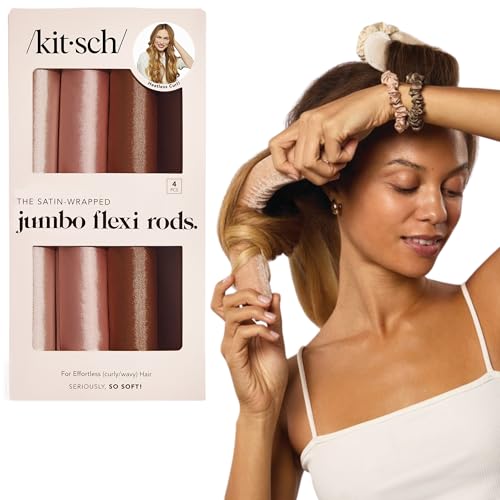
Flexi rods (Kitsch Jumbo, #4 in our list) produce a different curl shape than satin headbands — bigger, looser, with more "blowout" bounce vs the "old-Hollywood wave" you get from the headband technique. Two practical reasons to pick flexi rods: (1) you specifically want the salon-blowout look rather than long flowing waves, or (2) you're a side-sleeper who couldn't tolerate the headband shape against your scalp at night. Flexi rods are dramatically more comfortable to sleep in than headbands or foam rollers — the soft-foam-with-bend construction sits flat against the head with no rigid contact points.
Why are Curlformers so much more expensive than the other options?
Curlformers (#3) is the only no-heat method that produces tight, defined ringlet curls — the look you'd traditionally need a 1" curling iron and 30 minutes of styling for. The mesh-spiral mechanism is meaningfully different engineering from any other product on this list and has been salon-proven since 2009. The 40-curler kit is enough for full-head application and produces curls that hold for 24-48 hours after removal. The price reflects the manufacturing complexity and the mechanism's actual differentiation. If you don't want tight ringlets, you don't need Curlformers — go to RobeCurls or Kitsch instead. If you DO want ringlets and have been heat-curling for years to get them, Curlformers eliminates that variable and is genuinely worth the price.
Are foam rollers from the 1980s still actually competitive in 2026?
Yes, with caveats. The Conair 48-pc foam roller set (#5) is the longest-tenured heatless curling product on the market and produces excellent curls — the technique just hasn't changed in 40 years. Two reasons to pick foam rollers in 2026: (1) budget is the primary constraint and a sub-$15 set with 48 rollers in 4 sizes is genuinely the most coverage-per-dollar in the category, or (2) you have very long or very thick hair where the 4 rods of the satin-headband options aren't sufficient for full-head coverage. Two reasons NOT to: foam rollers are bulky to sleep in compared to flexi rods, and the curl pattern they produce is slightly more "vintage" / less "Instagram soft" than the modern satin-headband finish. But the engineering is sound and the price-per-curl is unbeatable.
How damp should my hair actually be when I start?
Damp, not wet. Soaking-wet hair takes too long to dry overnight (you wake up with still-wet curls that fall flat as they finish drying during the day), AND wet hair is in its weakest tensile state per Robbins 2012 (above), so wrapping it tight enough to form a curl can cause breakage. The right consistency: wash + towel-dry + air-dry for 10-20 minutes until hair is past dripping but still noticeably damp. Section-mist with water if your hair dried too fast in spots. The headband and flexi-rod methods are most forgiving on dampness; Curlformers and foam rollers benefit from slightly drier starting hair (60-70% dry) to set the spiral shape correctly.
Will heatless curls actually repair damage I already have from years of flat-iron use?
No — and any product or video that claims otherwise is overselling. Hair is dead protein. Once the cuticle is damaged, it doesn't structurally repair. Per the AAD guidance linked in the research section above, the only real recovery pathway for damaged hair is to stop further damage and let new healthier hair grow in (~6 inches/year). Heatless curls support that recovery by eliminating the thermal-damage variable going forward, but they don't reverse existing damage. The visible improvement people report after switching to heatless methods is partly real (less ongoing breakage) and partly the new growth becoming visible over 12-18 months of consistent no-heat styling.
Common heatless-curl mistakes
Mistake 1: starting with too-wet hair (the curls drop as the hair finishes drying during the day). Mistake 2: wrapping too loosely at the ends (the ends never form a curl and you wake up with flat-bottomed waves). Mistake 3: using regular elastic hair ties instead of satin scrunchies to secure the ends (the elastic creates a kink in the hair). Mistake 4: skipping the morning hairspray (heatless curls hold significantly better with a quick light-hold spray finish). Mistake 5: trying to fight your natural hair texture with the wrong format — fine hair often needs the smaller-diameter Curlformers or foam rollers; thick hair often needs the jumbo flexi rods or Curlformers' full kit (40 rollers). Mistake 6: not protecting the curl pattern at night after the first day (silk pillowcase + loose pineapple ponytail extends a 1-day curl into 2-3 days).