Editorial disclosure: We earn from qualifying Amazon purchases at no extra cost to you. Picks are independently researched. Full disclosure →
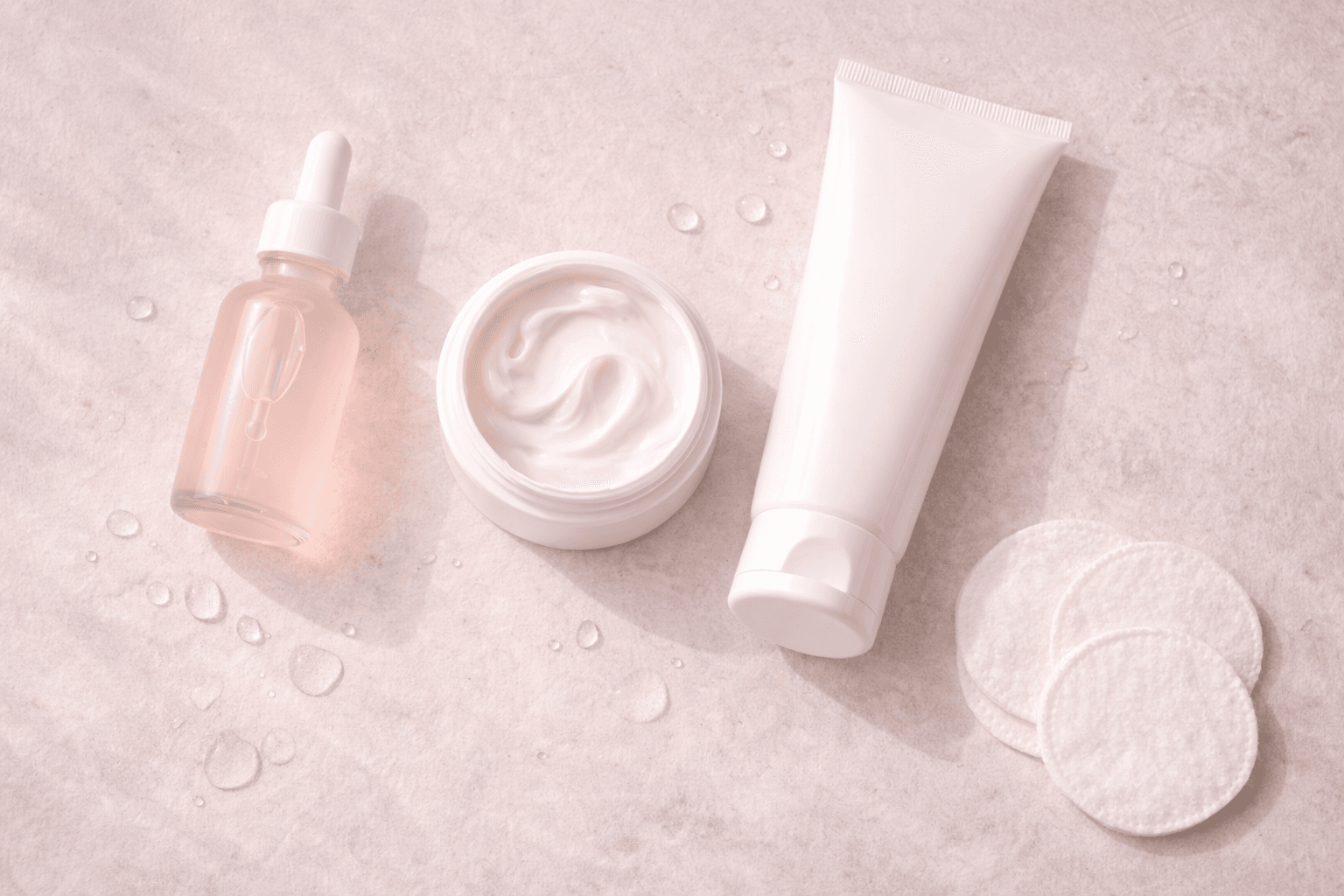
How to Layer Skincare Products in Your Morning Routine
Order: thinnest to thickest, water-based before oil-based, low-pH actives early. AM sequence: cleanser → vitamin C → hyaluronic acid → niacinamide → moisturizer → SPF. The biology behind each placement.
The short answer: thinnest to thickest, pH-active layers first
Quick answer
Standard AM order: (1) Gentle cleanser, (2) Toner/essence (optional), (3) Vitamin C serum at low pH ≤3.5, (4) Hyaluronic acid serum on damp skin, (5) Niacinamide serum, (6) Moisturizer, (7) SPF 30+ as the absolute final step. The principle is thinnest-to-thickest application — water-based products absorb into damp skin faster than oil-based — plus pH-dependent actives (vitamin C, AHA, BHA) need direct skin contact before moisturizers create a film. Sunscreen is always last because it forms a protective barrier that subsequent products would penetrate.
The two underlying principles that drive the standard order:
1. Texture viscosity governs absorption. Thin water-based products absorb into the upper skin layers (stratum corneum) within seconds. Thick oil-based or occlusive products create a film that subsequent water-based products can't penetrate. Apply thinnest first, work up to thickest.
2. pH governs active-ingredient efficacy. Vitamin C (L-ascorbic acid) is only stable and bioactive below pH 3.5 (Pinnell 2003). AHAs and BHAs work at acidic pH. If you apply a pH-neutral moisturizer first, then a low-pH active on top, the moisturizer's film prevents the active from reaching skin at its working pH. Acid-active layers go before moisturizers.
The 7-step morning routine, explained
Quick answer
Step 1: Gentle cleanser (or just water rinse — overnight, only sebum + dust accumulated; a harsh AM cleanser strips lipids). Step 2: Toner/essence (optional hydration boost). Step 3: Vitamin C serum (10-20% L-ascorbic acid, pH ≤3.5) — antioxidant defense for the day's UV/pollution exposure. Step 4: Hyaluronic acid serum (apply to slightly damp skin so HA pulls water IN, not OUT). Step 5: Niacinamide serum (compatible with vitamin C at modern formulations). Step 6: Moisturizer with ceramides + barrier lipids. Step 7: Sunscreen SPF 30+ as the absolute final step, two-fingers worth for face.
Step 1 — Cleanser. Overnight you accumulate sebum and dust. A gentle low-foam cleanser (CeraVe Hydrating, Vanicream, Cetaphil) removes these without stripping the skin's barrier lipids. Hot water and harsh sulfate cleansers are the most common AM mistakes — they damage the moisture barrier you spend the rest of the routine repairing.
Step 2 — Toner/essence (optional). A hydrating toner (containing glycerin, panthenol, or amino acids) primes the skin for the actives that follow. Skip the old-school astringent toners (witch hazel, alcohol) — they damage the barrier.
Step 3 — Vitamin C serum. 10-20% L-ascorbic acid at pH ≤3.5 is the evidence-supported form. Apply 3-4 drops, pat in, wait 60-90 seconds before the next step. Antioxidant defense + collagen synthesis cofactor. See our vitamin C serum rankings.
Step 4 — Hyaluronic acid serum. Apply to slightly damp skin. HA is a humectant that pulls water from its environment — if the environment is dry, it can pull moisture OUT of your skin, paradoxically dehydrating you. Pavicic 2011 demonstrated low-molecular-weight HA penetrates the upper dermis and increases skin hydration over 8 weeks.
Step 5 — Niacinamide serum. The old "don't use niacinamide with vitamin C" rule was based on outdated formulations; modern stabilized vitamin C + niacinamide pairs without interaction (Wohlrab 2014). Niacinamide reduces hyperpigmentation, redness, and pore size while supporting barrier function.
Step 6 — Moisturizer. Ceramide-based moisturizers (CeraVe AM, La Roche-Posay Toleriane) replenish barrier lipids depleted by cleansing and active layers. Apply while skin is still slightly damp from prior serums.
Step 7 — Sunscreen. The most important step in the entire routine for visible aging prevention (Hughes 2013, Annals of Internal Medicine). Use SPF 30+. Apply approximately 1/4 teaspoon (~2 fingers worth) to face + neck — most people under-apply by 50%+, which cuts the effective SPF protection accordingly (Sambandan 2011).
The four most common skincare-layering mistakes
Quick answer
Four patterns: (1) Applying vitamin C AFTER moisturizer — the moisturizer film blocks the acidic vitamin C from reaching skin at its working pH; vitamin C goes BEFORE moisturizer. (2) Applying HA to dry skin — HA pulls water from skin if the air is dry; apply to damp skin. (3) Skimping on sunscreen — most people use 1/2 the amount needed for labeled SPF; use a full 1/4 teaspoon for face. (4) Layering too many actives — 2-3 actives max per routine; more causes irritation without added benefit.
The sunscreen-under-application mistake is the highest-impact because it linearly cuts protection. Sambandan and Ratner (2011) measured real-world application thicknesses and found median application of ~0.5 mg/cm² vs. the 2 mg/cm² that SPF labels assume. At that under-application, an SPF 30 effectively delivers SPF 7-10 protection. Two-finger-strip rule: dispense sunscreen the length of your index AND middle finger from base to tip; that's approximately the right amount for face + neck.
The active-stacking mistake (4+ acid actives in one routine) causes irritation, inflammation, and barrier compromise — which then defeats the purpose. Stick to 2-3 actives across AM + PM combined. AM: vitamin C + niacinamide is a clean stack. PM: retinol + ceramide moisturizer. See our vitamin C + retinol compatibility guide for the AM/PM split protocol.
How long to wait between layers
Quick answer
60-90 seconds between water-based serum layers, 2-3 minutes between active serums and moisturizer, 5-10 minutes between moisturizer and physical sunscreen, immediate sequential application between water-based products of similar texture. The waiting isn't about absorption per se — most active ingredients absorb in seconds. It's about letting pH-dependent actives (vitamin C, AHA, BHA) reach skin at their working pH before subsequent layers form a film. If you're rushed, prioritize: vitamin C → wait → everything else can be sequential.
More peer-reviewed evidence from our editorial team
- Keratosis Pilaris — Urea, Lactic Acid, Salicylic Acid Trials
- Ingestible Beauty — Collagen, HA, Astaxanthin Evidence
- Anti-Aging Skincare 30s — Retinoid + Sunscreen Evidence
- Beta-Glucan Skincare — Pillai 2005 Dectin-1 Evidence
Every page in our editorial-evidence cluster cites peer-reviewed primary sources (PubMed, AAP, ACSM, NEJM).
GiftedPicks Editorial Team
Product Research & Editorial
The GiftedPicks editorial team researches thousands of Amazon products, analyzes customer review patterns, cross-references clinical studies and community recommendations, and writes original editorial content for every list. We never accept payment from brands for placement or ranking.