

the power bank market is confusing on purpose — here is what actually matters
Power bank listings on Amazon are designed to overwhelm you with numbers: 20000mAh, 65W, PD 3.1, QC 5.0, 140W bi-directional charging. Most of these numbers mean nothing without context. A 20,000mAh power bank sounds twice as good as a 10,000mAh one until you realize the 10,000mAh model with 45W output will charge your phone just as fast — you will just get fewer total charges. The capacity determines HOW MANY times you can charge. The wattage determines HOW FAST each charge happens. These are independent variables, and most buyers conflate them.
The other critical variable most listings bury: output wattage determines what DEVICES you can charge. A 22.5W power bank can fast-charge a phone but cannot meaningfully charge a laptop. A 65W power bank can charge a MacBook Air but will slow-charge a MacBook Pro 16". A 140W power bank handles virtually any USB-C laptop at near-wall-charger speeds. Matching the output wattage to your most demanding device is the single most important decision when choosing a power bank. Everything else — capacity, port count, display — is secondary.
Why Does Your 20000mAh Power Bank Not Deliver 20000mAh to Your Phone?
A power bank rated at 20,000mAh does not actually deliver 20,000mAh of usable power to your device. Energy is lost during voltage conversion (the internal battery operates at 3.7V but outputs at 5V-20V depending on the charging protocol) and through heat dissipation. Real-world efficiency typically ranges from 60-75%, meaning a 20,000mAh bank delivers roughly 12,000-15,000mAh of usable charge. This is why a 20,000mAh bank charges a 4,000mAh phone approximately 3-4 times rather than the theoretical 5 times.
Higher output wattage also reduces efficiency — a power bank delivering 140W loses more energy to heat conversion than one delivering 22.5W. This means the Anker 737 at 140W output will deliver fewer total phone charges from its 24,000mAh than the INIU 20000mAh at 22.5W output, despite the Anker having 4,000mAh more capacity. The Anker compensates by charging devices much faster and handling laptops, but total charge count is not purely a capacity number.
Can a Power Bank Really Charge Your Laptop? What Wattage Do You Actually Need?
USB Power Delivery (PD) is the charging protocol that enables power banks to charge laptops. Standard USB maxes out at 7.5W. USB PD allows negotiation between the charger and device to deliver up to 240W over USB-C. When a power bank says "65W PD" it means the USB-C port can negotiate with your device to deliver up to 65 watts — enough for a MacBook Air (which draws about 30W during use) or most ultrabooks. For larger laptops like the MacBook Pro 16" (which draws up to 140W under load), you need a 100W+ power bank, and even then the laptop will charge slowly during heavy use. For phones and tablets, any power bank with PD support will fast-charge — the difference between 22.5W and 45W is a matter of minutes, not hours. The output wattage matters most for laptop users.
Are Power Banks Allowed on Airplanes? What's the TSA Limit?
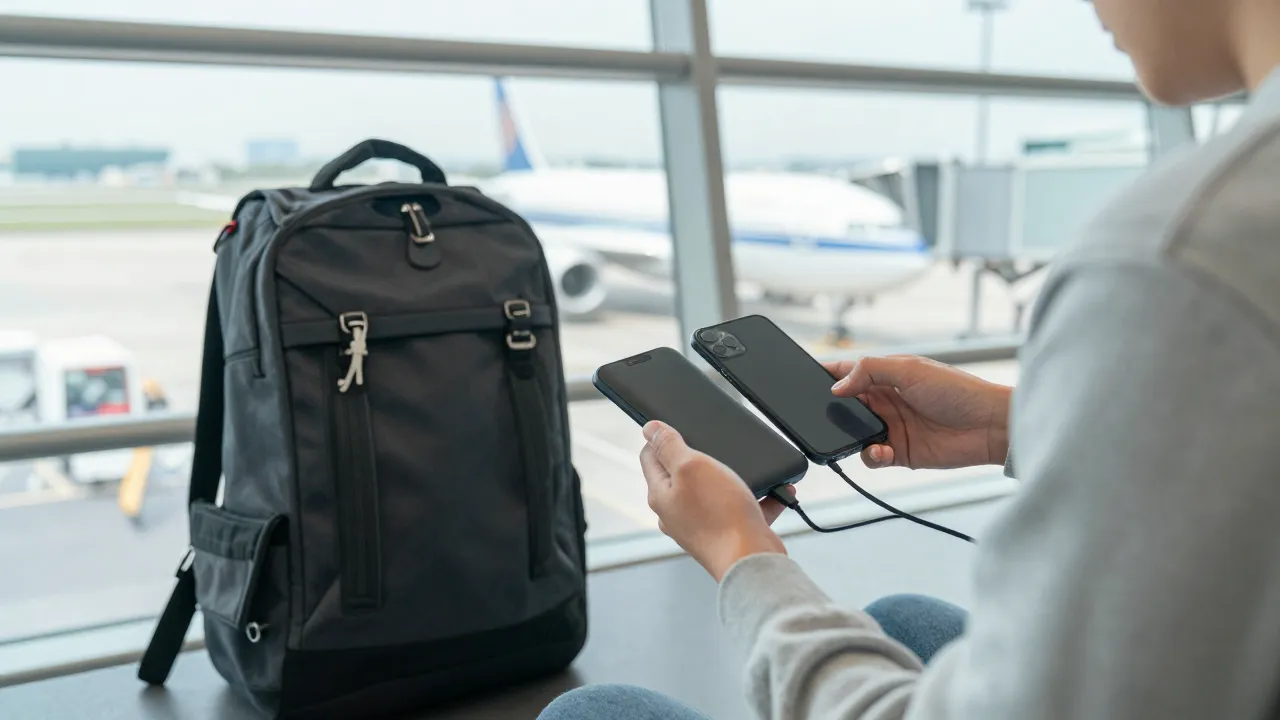
Airlines and the TSA have specific rules for lithium-ion batteries on planes. Power banks must be carried in your carry-on bag (never checked luggage). The TSA allows power banks up to 100 watt-hours (Wh) without special approval, and power banks between 100-160Wh require airline approval. To calculate Wh from mAh: multiply mAh by voltage (3.7V for most lithium batteries) and divide by 1000. A 20,000mAh bank is approximately 74Wh — well within limits. A 27,000mAh bank is approximately 100Wh — right at the line. Every power bank on this list is TSA-approved for carry-on without special permission, but the 30,000mAh Baseus sits at the edge at 111Wh and technically requires airline approval, though enforcement varies. If you travel frequently with our travel essentials picks, staying under 27,000mAh eliminates any TSA ambiguity.
choosing by use case
Daily commuter (phone only): INIU 10000mAh slim with built-in cable. It fits in a pocket, has no separate cable to forget, and fast-charges your phone 2-3 times. At $18-25, it is essentially disposable insurance against a dead phone.
Remote worker or student: Anker 737 Gen 2 or Baseus 65W 20000mAh. Both charge laptops and phones. The Anker is smaller with a built-in cable; the Baseus costs less with more ports. Either one means you can work from a coffee shop, library, or airport gate without hunting for outlets. Pair with gear from our WFH desk setup guide for a complete mobile office.
Business traveler with laptop: Anker 737 original (140W) or Anker Prime (200W). The 140W model handles any laptop at near-wall speed. The Prime adds faster self-recharging and higher total output for charging laptop + phone simultaneously at full speed.
Multi-day trip or camping: Baseus 30000mAh. Maximum capacity means 2-3 days of phone charging without access to a wall outlet. The 65W output can rescue a dying laptop in a pinch. Seven ports handle a group of devices. Check our tech accessories under $20 guide for complementary travel gadgets.
Budget priority: INIU 20000mAh at $22-30. No power bank offers more total phone charges per dollar. 22.5W is fast enough for phone charging. Over 28,000 reviews confirm reliability. This is the Costco-mentality choice — maximum volume for minimum cost.
Bottom line: Match the output wattage to your most demanding device, then choose capacity based on how many charges you need between wall outlets. The INIU 10K slim is the best everyday carry. The Anker 737 is the best laptop charger. The Baseus 65W 20K is the best value. Do not overspend on capacity you will not use — a 10,000mAh bank you actually carry beats a 30,000mAh bank sitting in a drawer at home.