Editorial disclosure: We earn from qualifying Amazon purchases at no extra cost to you. Picks are independently researched. Full disclosure →
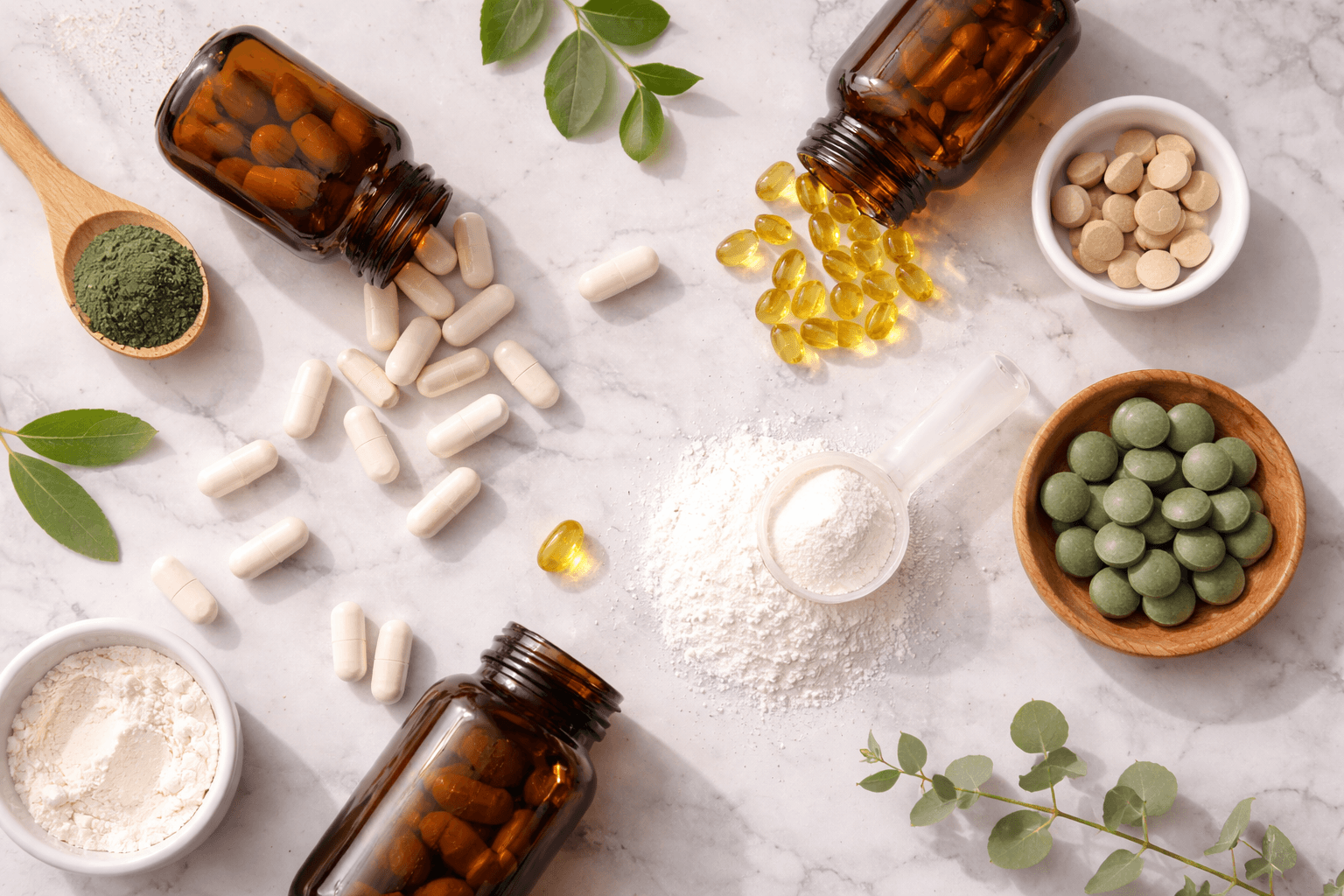
Do Greens Powders Actually Work?
For most people, no — they don't replace vegetables. But specific formulas with probiotics + digestive enzymes have legitimate RCT-backed benefits for bloating and gut function. The honest evidence breakdown.
The short answer: it depends entirely on the formula and what you're trying to achieve
Quick answer
Partially. Most greens powders DON'T replace vegetables — they're too low in fiber (1-3g/serving vs 5-15g in actual produce), and processing destroys some phytonutrients. But specific formulas with probiotics, digestive enzymes, and adaptogens DO have RCT-backed benefits: probiotic strains reduce IBS-related bloating (Ford 2014 meta-analysis, n=4,403), digestive enzymes reduce postprandial bloating (Money 2011), and prebiotic fibers feed beneficial gut bacteria (Slavin 2013). Bottom line: greens powders are NOT vegetable replacements but ARE legitimate supplements for specific gut/digestion outcomes.
The marketing framing of greens powders ("30 servings of vegetables in one scoop") is misleading. A typical scoop delivers 6-12g of dried plant material — equivalent in nutrient density to perhaps 1-2 servings of produce, with significantly less fiber and intact phytonutrient structure than whole foods. So as a vegetable replacement, they underperform vs. actually eating vegetables.
But framing them as "just a multivitamin" is also wrong. The published evidence supports specific functional benefits — particularly for bloating, gut microbiome support, and digestive enzyme activity — when the formula contains the right active ingredients at adequate doses. The trick is knowing which formula maps to which outcome.
What greens powders DO have evidence for
Quick answer
Three benefits are well-supported by RCT evidence: (1) Bloating reduction — multi-strain probiotic + digestive enzyme formulas reduce postprandial bloating in IBS patients (Ford 2014, Money 2011); (2) Gut microbiome diversity — prebiotic fibers (inulin, acacia, partially hydrolyzed guar gum) feed beneficial bifidobacteria and lactobacilli (Slavin 2013 review); (3) Antioxidant capacity — concentrated spirulina/chlorella/matcha/berry powders measurably raise plasma antioxidant markers (Kim 2014). They DON'T meaningfully replace dietary fiber, fresh produce, or comprehensive micronutrient intake.
Bloating reduction. Ford et al. in American Journal of Gastroenterology (2014) — meta-analysis of 43 RCTs (n=4,403) — found probiotic supplementation significantly reduced IBS-related bloating (RR 0.79). Money et al. in Gut (2011) showed digestive enzyme supplementation reduced postprandial bloating in functional dyspepsia. Greens powders bundling these (Bloom Greens, Athletic Greens AG1, Garden of Life) are biologically coherent for bloating-focused buyers.
Microbiome support. Slavin in Nutrients (2013) — comprehensive prebiotic review — established that inulin, FOS, and other fermentable fibers selectively increase bifidobacteria and short-chain fatty acid production. Greens powders with prebiotic fibers DO contribute to this, though dose matters: most products provide 1-3g prebiotic fiber per scoop, which is below the 5-10g/day threshold most studies use.
Antioxidant capacity. Kim et al. in International Journal of Vitaminology and Nutrition Research (2014) measured antioxidant biomarkers after 4 weeks of greens-powder supplementation and found measurable improvements in plasma ORAC and reduced lipid peroxidation. Effect was real but modest, and required formulas with concentrated polyphenol-rich ingredients (cocoa, matcha, berries) — not just spirulina/chlorella blends.
See our bloating-focused greens powder rankings for the formulas that actually deliver these effects.
What greens powders DO NOT do, despite marketing claims
Quick answer
Three common overclaims: (1) 'Replaces 30 servings of vegetables' — false. A scoop has 6-12g dry weight; fresh produce has 5-15g fiber per serving alone. The fiber gap (US adults average 15g/day vs the 25-38g recommended per Holscher 2020) won't be closed by greens powders. (2) 'Detoxes the body' — the liver detoxes; greens powders don't enhance hepatic phase-I/II enzymes meaningfully. (3) 'Boosts immunity in days' — immune adaptation is multi-week, not multi-day. Greens powders are real supplements with specific functional benefits, but not the panacea the marketing implies.
The vegetable-replacement claim. Holscher in Advances in Nutrition (2020) documented that US adults average ~15g dietary fiber/day vs. the 25-38g recommended by the Institute of Medicine. Greens powders don't close this gap — a typical 1-3g of fiber per scoop is a rounding error vs. the 10-20g deficit. The marketing claim that one scoop replaces "30 servings of vegetables" conflates antioxidant capacity (measurable but small) with overall produce nutrition (which includes fiber, water content, intact phytonutrient structure, and chewing/satiety signals that powders can't replicate).
The detox claim. The liver performs phase-I and phase-II detoxification via cytochrome P450 enzymes and conjugation reactions. There's no peer-reviewed evidence that greens powders meaningfully upregulate hepatic detox enzymes at consumer doses. Cruciferous vegetables (broccoli, kale) contain sulforaphane which DOES induce phase-II enzymes — but powdered, processed versions retain only fractional bioactive sulforaphane vs. fresh chewed cruciferous (Conaway 2000, Cancer Letters).
The immunity claim. Immune system adaptation requires weeks. Most greens powder marketing implies day-scale immune benefit, which isn't mechanistically plausible.
Who actually benefits from greens powders
Quick answer
Four scenarios with clear evidence: (1) IBS or chronic bloating — multi-strain probiotic + enzyme formulas (Ford 2014, Money 2011); (2) Low-vegetable-intake adults during travel or hectic life phases — a placeholder is better than nothing; (3) Athletes wanting baseline antioxidant support for high-volume training (Kim 2014); (4) Post-antibiotic gut recovery — probiotic strains help rebuild microbiome diversity. Who SHOULDN'T: anyone already eating 5+ servings of vegetables daily with no GI symptoms — you're paying $50-90/month for marginal benefit.
The most honest evaluation is to ask: what specific problem am I trying to solve? If the answer is "I want to eat more vegetables" — the right move is to eat more vegetables, not buy a powder. If the answer is "my IBS bloating is wrecking my workday," a probiotic + enzyme formula has real RCT support. If the answer is "I'm an athlete with high oxidative-stress demands," an antioxidant-concentrated formula may help. If the answer is vague ("feel better, more energy") — you're probably buying placebo + caffeine + the satisfaction of a routine.
For specific use cases, see: bloating-focused formulas, AG1 alternatives that cost less, and stevia-free greens powders.
The honest greens-powder buying criteria
Quick answer
Five evidence-based criteria: (1) Probiotic strains specified BY NAME and CFU count (L. acidophilus, B. lactis, L. plantarum) — not 'probiotic blend X billion CFU'; (2) Digestive enzymes named (amylase, lipase, protease) with activity units; (3) Prebiotic fiber listed by source (inulin, acacia, FOS) NOT generic 'fiber blend'; (4) Third-party testing for heavy metals (greens-source plants accumulate lead, cadmium, arsenic — Consumer Lab has flagged multiple brands); (5) Skip products with 'proprietary blend' labels that hide individual ingredient doses below the active threshold.
The proprietary-blend tell is the biggest scam signal. If a brand lists "Wellness Blend 8.5g" with 47 ingredients inside, every individual ingredient is likely at sub-therapeutic doses — the formulation is designed to look impressive on the label without providing meaningful active doses. Reputable formulas disclose individual probiotic CFU counts, enzyme activity units, and fiber gram amounts so you can verify the doses match the published evidence.
The heavy metals point is non-trivial. Spirulina, chlorella, wheatgrass, and other algae/grass ingredients accumulate cadmium, lead, and arsenic from growing conditions. Consumer Lab's 2023 review found 22% of tested greens powders exceeded California Prop 65 thresholds for at least one heavy metal. Third-party COA documentation is the only protection.
More peer-reviewed evidence from our editorial team
- Greens Powders for Bloating — Probiotic + Enzyme RCT Evidence
- Collagen for Men — Joint & Tendon RCT Evidence
- Supplement Stockpiling — Stability + Shelf Life Evidence
- AG1 Alternatives — Adaptogen + Probiotic Evidence Review
Every page in our editorial-evidence cluster cites peer-reviewed primary sources (PubMed, AAP, ACSM, NEJM).
GiftedPicks Editorial Team
Product Research & Editorial
The GiftedPicks editorial team researches thousands of Amazon products, analyzes customer review patterns, cross-references clinical studies and community recommendations, and writes original editorial content for every list. We never accept payment from brands for placement or ranking.