


The complete Joovv vs Mito Red Light buyer's guide
Joovv pioneered the consumer red light therapy category and built the premium brand most associated with the technology. The catch: Joovv-branded panels are direct-to-consumer only — they're not sold on Amazon. So the practical comparison on Amazon is Mito Red Light (the closest premium-quality alternative) vs. budget panels (Hooga, BestQool) vs. portable options (Mito Mobile). All four use the same 660nm + 850nm wavelengths because that's what the science supports — the differences are in irradiance, EMF, build quality, and warranty terms.
Why isn't Joovv on Amazon — and does it matter?
Joovv distributes exclusively through joovv.com to maintain pricing control, warranty registration, and direct-to-consumer relationships. From a buyer perspective, this means: no Amazon Prime shipping, no Amazon return policy, and no Amazon review volume to cross-reference. Mito Red Light made the opposite distribution decision — full Amazon presence with the same premium positioning — which is why MitoMIN 2.0 ends up as the practical Amazon-equivalent of mid-tier Joovv panels. If Joovv brand specifically matters to you, you'd order from joovv.com. If panel specs matter more than brand, Mito on Amazon is the better path.
Joovv vs Mito Red Light: what's the actual difference?
Both brands use the same 660nm + 850nm dual-wavelength formulation backed by Hamblin 2017 photobiomodulation research. Both publish irradiance and EMF specs. Both offer 3-year warranties. The differences: Joovv has stronger brand recognition (years of marketing investment), modular daisy-chaining (you can connect multiple Joovv panels for whole-body coverage in a way Mito doesn't fully match), and an iOS/Android app that tracks sessions. Mito's differentiation is publishing the lowest EMF readings in the category (0.0 µT at 6 inches vs. Joovv's typical 0.1-0.3 µT) and pricing 30-50% lower per equivalent panel size. For most users, the spec parity at lower price wins; for users committed to the Joovv ecosystem with multiple panels, Joovv's modular system is hard to replicate elsewhere.
Why does EMF matter for red light panels?
Red light therapy involves face-proximity exposure (often 6-12 inches from a panel emitting electromagnetic energy from LEDs and driver electronics) for 10-20 minute sessions, often daily, sometimes for years. Concern over chronic EMF exposure is non-trivial for users who plan long-term daily use. Mito Red Light is the only major brand publishing third-party-tested EMF readings showing 0.0 µT at 6 inches — an order of magnitude lower than typical consumer electronics at that distance. Hooga and BestQool don't publish EMF specs, which doesn't mean they're high — it means you don't know. For occasional use this likely doesn't matter; for daily multi-year use, the published EMF transparency is what makes Mito's premium pricing defensible.
Hooga vs BestQool: which budget pick wins?
Both are sub-$250 panels with the correct 660nm + 850nm wavelengths. BestQool wins on irradiance (~100+ mW/cm² vs. Hooga's ~80-90 mW/cm² at equivalent distance) and offers selectable wavelength modes (red-only, NIR-only, or both). Hooga wins on Amazon review volume (more verified buyer feedback to read), brand familiarity (Hooga is the more recognizable budget-tier name), and slightly lower price point. Functionally, both deliver the wavelength science the published research validates. Pick Hooga if you want maximum verified review volume to draw from; pick BestQool if you want the higher irradiance and selectable modes for more session-design flexibility.
When does the portable Mito Mobile make sense?
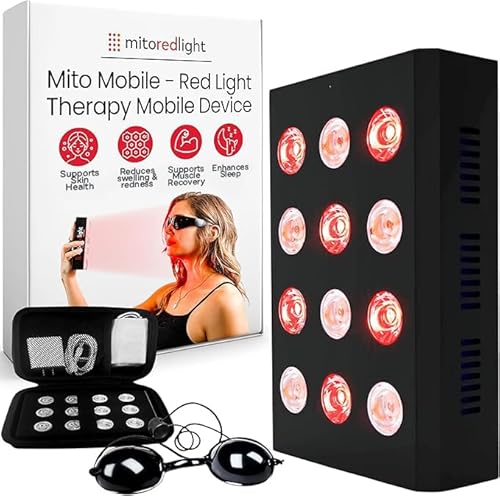
The Mito Mobile is a different use case — not a primary panel competitor. It's designed for travel (small enough for a carry-on), targeted treatment (face-only anti-aging, joint-only recovery), and consistency support (people who travel for work and don't want to break their red light habit). It is NOT meant to replace a wall-mounted panel for whole-body treatment — the surface area is too small. Buy the Mito Mobile in addition to a wall panel, not instead of one. As a standalone device for users who only care about face-area anti-aging or single-joint application, it works well; as a primary device for users wanting whole-torso recovery, you'd be better served by any of the larger panels.
How long until I see results from red light therapy?
Photobiomodulation effects accumulate over weeks. The published literature (Wunsch & Matuschka 2014, Avci 2013) typically uses 30-session protocols at 3-5 sessions per week — meaning measurable skin and tissue changes show up at 6-10 weeks of consistent daily use. Acute effects (post-workout muscle soreness reduction, sleep quality improvements) often appear within 1-3 weeks. The mistake users make is buying a panel, using it sporadically for 2 weeks, then declaring it doesn't work. Red light therapy is a discipline tool — the device you use 5x/week for 8 weeks delivers results; the device you use occasionally doesn't. Buy the panel you'll actually keep using.
What about cheaper sub-$100 Amazon panels?
Below ~$100, the failure modes get serious: incorrect wavelength peaks (LEDs labeled "660nm" actually emitting at 620-640nm), insufficient irradiance to reach therapeutic dose in reasonable session length, fan failure within 6-12 months, and EMF emissions in the µT range that more expensive panels avoid. The Hooga and BestQool picks above are the floor — below their price points, the spec compromises start to undermine the photobiomodulation effect entirely. If your budget is genuinely below $150, you're better off saving until you can buy Hooga than buying a $60 panel with questionable wavelength accuracy.