Editorial disclosure: We earn from qualifying Amazon purchases at no extra cost to you. Picks are independently researched. Full disclosure →

Plastic Detox Clothing: 10 Natural-Fiber Basics for a Polyester-Free Wardrobe
Roughly 70 percent of the world's textiles contain synthetic — that is, plastic — fibers, and your closet is statistically no exception. The Plastic Detox documentary sent thousands of viewers searching for natural-fiber clothing brands; this is the verified, label-checked version of that list, plus a guide to reading fiber labels yourself.
💡 Affiliate Disclosure: We earn a small commission from Amazon purchases made through our links. This supports our work. We only recommend natural-fiber basics we'd hand a friend who asked us where to start.
Our Top Plastic Detox Clothing Picks on Amazon
We did the research for you — curated and reviewed the top-rated products so you can find what's actually worth buying. 100% free.
Quick answer
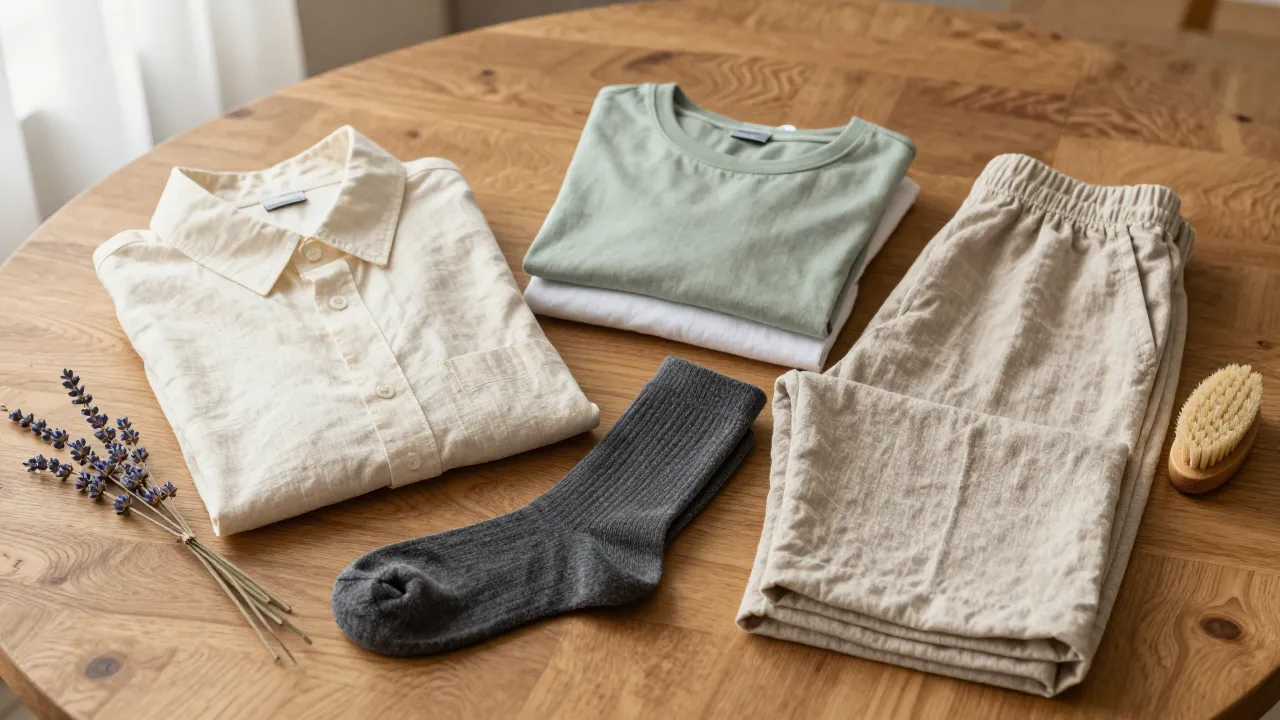
Roughly 70 percent of the world's textiles contain synthetic fibers — polyester, nylon, acrylic — and they shed microplastic fragments in every wash. The plastic detox swap is choosing 100 percent natural fibers instead: organic cotton, linen, and merino wool. The ten verified picks below cover tees, shirts, socks, underwear, sleepwear, and base layers.
See natural-fiber basics on AmazonQuick Comparison
Quick Comparison — Jump to Your Best Pick
| Best For | Product | Price | Why It Wins | |
|---|---|---|---|---|
| Start Here | Organic Basics Organic Cotton Tee 3-Pack | Est. $$ | The t-shirt is the most-worn, most-washed garment in nearly every closet, which makes it the most leveraged single swap. A plain organic cotton three-pack replaces the polyester-blend tees you'd be rebuying anyway — no style change, no learning curve, all natural fiber. | Check Price → |
| Highest Contact Hours | Ultimate Pure Comfort Organic Cotton Briefs 8-Pack | Est. $$ | Underwear logs more direct skin-contact hours than any other garment category, and the mainstream market is nylon-polyester microfiber. One organic cotton eight-pack swaps the entire drawer in a single purchase — the rip-the-bandage-off move. | Check Price → |
| Best for Winter | MERIWOOL 100% Merino Midweight Base Layer | Est. $$ | Thermal base layers are a polyester-dominated category where the natural fiber genuinely performs better, not just cleaner. 100 percent merino per the title — rare on Amazon, where most "merino" layers are blends — and its odor resistance means fewer wash cycles, which is itself a shedding win. | Check Price → |
| Best for Summer | Willit Cotton-Linen Wide Leg Palazzo Pants | Est. $$ | The honest answer to the legging problem: no natural fiber performs like Lycra, so swap the silhouette instead. Wide-leg cotton-linen palazzos give the same throw-on ease with zero synthetic fiber against skin, in the cut that's been dominant for several seasons. | Check Price → |
Organic Basics Organic Cotton Tee 3-Pack
The t-shirt is the most-worn, most-washed garment in nearly every closet, which makes it the most leveraged single swap. A plain organic cotton three-pack replaces the polyester-blend tees you'd be rebuying anyway — no style change, no learning curve, all natural fiber.
Check Price on Amazon →Ultimate Pure Comfort Organic Cotton Briefs 8-Pack
Underwear logs more direct skin-contact hours than any other garment category, and the mainstream market is nylon-polyester microfiber. One organic cotton eight-pack swaps the entire drawer in a single purchase — the rip-the-bandage-off move.
Check Price on Amazon →MERIWOOL 100% Merino Midweight Base Layer
Thermal base layers are a polyester-dominated category where the natural fiber genuinely performs better, not just cleaner. 100 percent merino per the title — rare on Amazon, where most "merino" layers are blends — and its odor resistance means fewer wash cycles, which is itself a shedding win.
Check Price on Amazon →Willit Cotton-Linen Wide Leg Palazzo Pants
The honest answer to the legging problem: no natural fiber performs like Lycra, so swap the silhouette instead. Wide-leg cotton-linen palazzos give the same throw-on ease with zero synthetic fiber against skin, in the cut that's been dominant for several seasons.
Check Price on Amazon →Clothing is one exposure pathway — see how your full routine ranks.
8 quick questions across water, food storage, cookware, beverages, and personal care. Get a 0–100 score plus the top 3 swaps that would actually move the needle for you.
0 of 8 answered
Why Your Closet Is Probably Mostly Plastic
When people start a plastic detox, they go for the kitchen first — water bottles, food storage, cookware. The closet comes last, if at all, because clothing doesn't feel like plastic. But polyester, nylon, and acrylic are petroleum-derived plastics in fiber form, and together they account for roughly two-thirds to 70 percent of global textile production. The shirt that feels like soft cotton jersey is often a cotton-poly blend; the "satin" pajama set is almost always 100 percent polyester; the cozy fleece blanket-hoodie is plastic through and through. If you watched the Plastic Detox documentary and then went looking for the clothing brands it pointed to, here's the honest framing: the documentary made the case against synthetic fibers in general, and what viewers are actually searching for is a starting set of natural-fiber clothing that doesn't require rebuilding a wardrobe from scratch. That's what this page is — and the section directly below names the textile companies that genuinely appear in the film, which is not the same list most viewers are expecting.
The exposure mechanism for clothing is different from food containers. Synthetic garments shed microplastic fibers mechanically — every wash cycle abrades the fabric and flushes fibers into wastewater, and worn fabric sheds fibers into household dust. Laboratory studies have measured hundreds of thousands of microfibers released from a single domestic wash load of synthetic textiles, and synthetic microfibers are among the most commonly identified microplastic types in environmental sampling. Clothing is also the longest skin-contact product category you own: underwear, base layers, and sleepwear sit against your skin for most of the 24-hour day. The swap logic that drives the rest of our complete plastic detox guide — prioritize high-contact, high-frequency items — points squarely at the basics drawer, not the going-out clothes.
One category deserves its own honest caveat: activewear. No natural fiber performs like polyester-elastane for compression and sweat-wicking, and pretending otherwise produces swaps that get abandoned in a month. We handle that category separately in our plastic detox activewear guide — this page covers the everyday 90 percent of the wardrobe where natural fibers genuinely work as well or better: tees, shirts, pants, socks, underwear, sleepwear, and thermals. And if you're extending the same logic to the textiles you sleep on rather than in, our bedroom and sleep swaps guide covers sheets, blankets, and pillows.
Which Clothing Companies Actually Appear in The Plastic Detox?
This is the single most common question we get from documentary viewers, and the answer has a twist: the film does feature apparel companies — but none of them is a clothing label you can shop. They are supply-chain and materials companies, which is why searching the film's "clothing brand" leads nowhere. Here is the verified list, with sources.
| Who appears | What they actually make | Can you buy clothing from them? |
|---|---|---|
| California Cloth Foundry Lydia Wendt, founder — credited on screen as an expert | A textile and dye supply chain built without petrochemicals or microplastics. Wendt founded it in 2014 and coined the term "Natural Fashion." | Not as a general consumer line, and not on Amazon. It is primarily a fabric and dye supplier to other brands. |
| Sparxell Dr. Benjamin Droguet, founder | Plant-based structural colour — pigment-free dye that creates colour through microscopic structure, the way a morpho butterfly's wing does, instead of through plastic-based pigments. | No. It is a business-to-business colour platform still scaling up through pilot programmes. |
Both appear because the film widens its lens past the six couples' homes into how plastic gets into products upstream — including, per the trade press covering Sparxell's appearance, fashion designers working to remove plastic-based fibres and potentially toxic dyes from their supply chains. Sources: the documentary's official film and credits page, which lists Lydia Wendt among the on-screen experts, and Just Style's March 2026 report on Sparxell's appearance.
What the film did not do is endorse a shoppable clothing brand. The couples' own closet changes were generic rather than branded — the production's official summary describes them replacing sources of endocrine-disrupting chemicals across their kitchens, bathrooms, laundry rooms and closets, and identifying hidden plastics in clothing, while in post-film interviews the participants said they chose cotton, wool, or linen for their babies' clothing. So if you came here looking for "the brand from the documentary," the honest answer is that the actionable takeaway is a fiber rule, not a brand name — which is what the label decoder below and the picks above are for. We trace every widely-circulated "the film recommends" claim to its source in our attribution audit of what Dr. Shanna Swan actually recommends, including the claims she never made.
How to Read a Clothing Label for Plastic
This is the skill the documentary searchers actually need, because fiber-content labels are legally required and completely honest — brands just count on nobody reading them. Every garment sold in the US must list its fiber content by percentage. Here is the full decoder:
Fiber Names That ARE Plastic
Polyester, nylon, polyamide, acrylic, elastane, spandex, Lycra, polypropylene. All petroleum-derived synthetic polymers — plastic in fiber form. "Polyamide" is just nylon's technical name, and elastane, spandex, and Lycra are three names for the same stretch fiber. Also watch for "microfiber," which describes ultra-fine synthetic fibers (usually polyester or a polyester-nylon mix), and "fleece," which is almost always polyester. If the percentage line includes any of these names, that share of the garment is plastic.
Fiber Names That Are Natural
Cotton, linen, hemp, wool, merino wool, cashmere, alpaca, silk, down. These are plant or animal fibers — fully natural, no petroleum feedstock. "Organic cotton" and "Pima cotton" are quality and farming distinctions within cotton; both are natural fiber. A label that reads "100% cotton" or "100% merino wool" is the unambiguous green light this page filters for.
The Trap Category: Semi-Synthetics and Weave Names
Rayon, viscose, modal, lyocell, Tencel, and "bamboo" fabric occupy a genuinely confusing middle ground. They're made from plant cellulose — wood pulp or bamboo — so they are not petroleum plastic, but the cellulose is chemically dissolved and re-extruded into fiber through heavy industrial processing. Nearly all "bamboo" clothing is technically bamboo viscose, and the US FTC has repeatedly taken action against brands marketing it as if it were natural bamboo fiber. Reasonable plastic-detoxers land differently on this category; our take is that semi-synthetics are a meaningful step above polyester but a step below true naturals, and they don't make this list. Separately, beware weave names posing as fibers: "satin," "silky," "velvet," "flannel," and "jersey" describe how fabric is woven or knitted, not what it's made of. Satin can be woven from silk — but at typical Amazon price points it's woven from polyester. The weave name on the front of the listing means nothing; the fiber percentage line means everything.
What About the Synthetics You Still Own?
A clothing plastic detox is a replace-as-you-rebuy project, not a closet purge — throwing away functional polyester clothes just moves the plastic to a landfill faster. For the synthetic garments still in rotation, the general microfiber guidance is: wash them less often, in colder water, on shorter cycles, in fuller loads (less agitation per garment), and line-dry when you can — each of these measurably reduces fiber shedding per wash. Microfiber-catching laundry bags and machine filters, which capture fibers before they reach wastewater, are covered along with detergents and dryer alternatives in our plastic detox laundry guide.
What the Research Says About Synthetic Clothing and Microplastics
The clothing-microplastic connection is one of the better-documented pathways in the microplastics literature — here's what the peer-reviewed work actually shows, without the documentary dramatization.
Domestic laundry is a measurable, repeatable source of microfiber release. Napper and Thompson, published in Marine Pollution Bulletin (2016), ran controlled wash cycles on polyester, polyester-cotton, and acrylic fabrics and measured fiber release on the order of hundreds of thousands of microfibers per typical wash load, with acrylic shedding the most and polyester-cotton blends the least. De Falco et al., published in Scientific Reports (2019), measured microfiber release from real synthetic garments across wash conditions and confirmed that wash temperature, detergent type, and load agitation all change shedding rates — the mechanistic basis for the cold-short-full wash guidance above.
Textile fibers were among the first microplastics identified at scale in the environment. Browne et al., published in Environmental Science & Technology (2011), sampled shorelines on six continents and found microplastic fibers whose polymer profile matched sewage effluent and washing-machine discharge — the study that first connected the laundry pathway to environmental microfiber accumulation. Synthetic textiles are consistently estimated as one of the largest sources of primary microplastics released to the ocean in assessments such as the IUCN's global review of primary microplastic sources.
The honest limits of the evidence: what's well-established is that synthetic textiles shed plastic microfibers during washing and wear, that those fibers persist in the environment, and that humans inhale and ingest microplastic fibers from household dust and other sources. What is not yet established is a quantified human-health harm threshold from textile-derived microfiber exposure specifically — the human-health research is early, and we won't overstate it. The case for natural-fiber clothing is precautionary source reduction at one of your highest-contact product categories, not a treatment claim. Natural fibers like cotton and wool also shed in the wash — the difference is that cellulose and protein fibers biodegrade, while petroleum-based fibers persist.
Sources: Napper & Thompson, fiber release from domestic washing machines, Marine Pollution Bulletin (2016) — DOI | De Falco et al., microfiber release from synthetic clothes, Scientific Reports (2019) — DOI | Browne et al., accumulation of microplastic on shorelines worldwide, Environmental Science & Technology (2011) — DOI | IUCN — primary microplastics in the oceans review | Textile Exchange — Materials Market Report (global fiber production shares)
How We Selected these products
The GiftedPicks team evaluates Amazon products against five criteria before any pick makes our lists. Here's exactly what we look for:
Review threshold
Strong customer satisfaction based on extensive review analysis. — not inflated by one-time purchase incentives.
Trending signal
Tracked against current Amazon search trends and GiftedPicks keyword data to confirm buyer demand exists before we recommend.
Price-to-value
Compared against category alternatives at similar price points. We flag when a pricier option genuinely outperforms its cheaper alternatives.
Review consistency
We weight recent reviews over historical ones. A product with consistent praise over 12+ months outranks one that spiked and faded.
Honest tradeoffs
Every pick includes what it's not ideal for. If a product doesn't suit a specific hair type, budget, or use case, we say so.
Category criterion 1
Fiber content verified against the actual product listing — picks with 100 percent natural fiber confirmed in the title are flagged as such, and every blend on this list is labeled as a blend. No product is described as more natural than its fiber line says it is.
Category criterion 2
Skin-contact hours prioritized — underwear, sleepwear, base layers, and tees beat outerwear because they touch skin longest and get washed most often.
Category criterion 3
Realistic adoption over purity — a merino-nylon hiking sock that lasts years beats a 100 percent merino sock that wears through in months. Where a blend is the honest engineering answer, we say so and explain the tradeoff.
As an Amazon Associate, GiftedPicks earns a commission when you purchase through our links — at no extra cost to you. Our editorial process is independent of this.
The 10 Natural-Fiber Basics — Ranked by Skin-Contact Hours
You might also like
Related guides in the plastic detox cluster: The Ultimate Plastic Detox Hub, The Complete Plastic Detox Shopping List, Plastic Detox Activewear, Plastic Detox: Bedroom & Sleep, and Plastic Detox: Laundry & Cleaning.
Frequently Asked Questions
Is polyester clothing actually plastic?
Yes — polyester is polyethylene terephthalate (PET), the same polymer family as plastic water bottles, extruded into fiber form. Nylon, acrylic, elastane/spandex, and polypropylene are likewise petroleum-derived synthetic polymers. Roughly two-thirds to 70 percent of global textile production is synthetic fiber, with polyester alone accounting for the majority of that. When a fiber label lists any of these names, that percentage of the garment is plastic, and controlled wash studies show these fabrics shed microplastic fibers in every laundry cycle.
What clothing brands were in the Plastic Detox documentary?
The documentary made the case against synthetic fibers generally — it is not a brand endorsement vehicle, and none of the products on this page appeared in or are affiliated with the documentary or Netflix. What viewers searching for "clothing brand from the plastic detox documentary" actually need is the underlying swap the film argues for: replacing polyester, nylon, and acrylic garments with 100 percent natural fibers like organic cotton, linen, and merino wool. One verifiable detail from the record: in post-film interviews published by Netflix, the participants themselves said they chose cotton, wool, or linen for their babies' clothing — their own purchasing decision, not a brand endorsement by the film or its scientists. This page is our independently verified, label-checked starting list for exactly that swap.
Is bamboo fabric plastic-free?
Bamboo fabric is not petroleum plastic, but it is also not the natural fiber it markets itself as. Nearly all "bamboo" clothing is bamboo viscose — plant cellulose chemically dissolved and re-extruded into fiber through heavy industrial processing, the same process as rayon. The US FTC has repeatedly taken action against brands marketing bamboo viscose as natural bamboo fiber. It occupies a middle ground: a step above polyester because the fiber biodegrades, a step below true naturals like cotton, linen, and wool. We left semi-synthetics off this list entirely.
Does a small percentage of elastane ruin a plastic detox?
It depends on your goal, and perfectionism is the wrong frame. A sock that is 98 percent cotton with 2 percent stretch fiber keeps the cuff functional — a truly 100 percent cotton sock slouches down your calf. Same with merino hiking socks, where a nylon share at the heel and toe is what stops the sock from wearing through in months. The realistic goal is flipping the dominant fiber from synthetic to natural across your highest-contact garments, not achieving zero synthetic content. Where 100 percent natural works without a durability penalty — tees, pajamas, base layers — choose it; where a small synthetic share is the honest engineering answer, accept it knowingly.
Do natural fibers also shed in the washing machine?
Yes — cotton, linen, and wool all shed fibers during washing, sometimes in comparable quantities to synthetics. The difference is what happens next: cellulose and protein fibers biodegrade in the environment, while petroleum-based fibers persist and fragment. That distinction is the core of the swap. For the synthetic garments you still own, shedding can be reduced with colder water, shorter cycles, fuller loads, line drying, and a microfiber-catching wash bag — our laundry guide covers the full setup.
Should I throw out all my polyester clothes at once?
No — a closet purge just moves the plastic to a landfill faster and replaces functional clothing at real cost. The sustainable version of a clothing plastic detox is replace-as-you-rebuy: when a polyester item wears out, replace it with a natural-fiber version, starting with the highest skin-contact categories — underwear, sleepwear, base layers, and everyday tees. In the meantime, wash the synthetics you keep less often, colder, and in fuller loads to reduce microfiber shedding per cycle. Most wardrobes can flip majority-natural within a year or two of normal replacement purchases.
You Might Also Like
What Reddit Communities Are Saying
Real discussions from verified Reddit users — not sponsored content
Reddit communities provide authentic peer reviews and recommendations, helping shoppers discover products that genuinely deliver on their promises.
Popular search: “plastic detox clothing natural fabrics reddit”
GiftedPicks Editorial Team
Product Research & Editorial
The GiftedPicks editorial team researches thousands of Amazon products, analyzes customer review patterns, cross-references clinical studies and community recommendations, and writes original editorial content for every list. We never accept payment from brands for placement or ranking.
10 research-backed picks curated by the GiftedPicks team
The label-checked wardrobe pass: ten natural-fiber basics ranked by skin-contact hours, with every blend honestly labeled as a blend. Built for the documentary searcher who wants the swap, not a brand fantasy.
Explore Related Topics
Ready to swap your wardrobe basics?
Shop the 10 natural-fiber clothing picks on Amazon.