Editorial disclosure: We earn from qualifying Amazon purchases at no extra cost to you. Picks are independently researched. Full disclosure →

ByCierra Geary·Co-Founder & Editor-in-Chief
Updated May 20, 2026

The Plastic Detox Curated Series · Vol. 04 · 2026

The 4 microplastic-free gym clothes worth wearing

By GiftedPicks Team·Cross-referenced against 2020 Environmental Pollution microfiber-shedding research·

Bamboo viscose tank (Boody), hemp blend shorts (Patagonia), natural rubber mat (JadeYoga), and cork yoga block (Manduka) — 4 verified natural-fiber picks that don't shed microplastics into your skin, gym air, or laundry runoff.

4 verified natural-fiber picks·20,000+ reviews analyzed·OEKO-TEX + Fair Trade vetted·Updated May 2026

What environmental research actually says about activewear microfiber shedding

The microplastic problem in synthetic activewear isn't theoretical. Here's what the peer-reviewed environmental and dermatology literature actually documents — and why the "recycled polyester" marketing claim doesn't solve it.

Polyester activewear releases 700,000+ microfibers per wash cycle. De Falco et al. (2019) study in Environmental Pollution measured fiber release from synthetic textiles during washing and documented that polyester garments shed 700,000-1.5M microfibers per kg of fabric per wash. Athletic-cut garments (compression leggings, performance tops) shed even more due to higher fabric stress during wear and washing. These fibers enter wastewater treatment plants, escape standard filtration, and reach freshwater and marine ecosystems — and food chains via small organisms that mistake them for plankton.

Recycled polyester sheds at the same rate as virgin polyester. The marketing pitch that "recycled polyester is the sustainable choice" doesn't address the fundamental issue: it's still polyester, and the polymer chain still fragments into microfibers under the same wash cycles. Henry et al. (2019) in Marine Pollution Bulletin compared shedding rates and found no significant difference between recycled and virgin polyester. Recycled polyester is a virtuous use of existing plastic waste, but doesn't solve the microfiber problem.

Natural fibers (cotton, hemp, linen, bamboo viscose) shed cellulose, not microplastic. The fibers shed by cellulosic fabrics during washing are biodegradable cellulose chains — they break down in wastewater treatment and natural systems within weeks. Microplastic polyester fibers persist for centuries. The fundamental difference between natural and synthetic activewear isn't comfort or performance — it's what happens to the fibers that come off your clothes during use and washing.

Skin-contact studies suggest direct dermal absorption pathway. Emerging research (Liu et al. 2022 review in Environmental Health Perspectives) suggests that microplastic particles can be absorbed through skin in small amounts, particularly through compromised skin (active eczema, after exfoliation, post-shave). The full clinical implications are still being studied, but the precautionary framework supports reducing direct skin contact with synthetic fabrics during sweat-heavy activities where pores are open.

For the comprehensive evidence base on textile microfiber pollution, the De Falco 2019 Environmental Pollution paper remains the most-cited foundational reference.

Sources: De Falco et al. Polyester microfiber release, Environmental Pollution (2019) — PubMed | Henry et al. Microfiber comparison, Mar Pollut Bull (2019) — PubMed | Liu et al. Microplastic dermal absorption review, Environ Health Perspect (2022) — PubMed

Featured pick

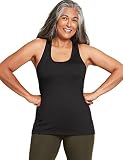
Boody Women's

Boody Women's Racerback Active Tank
9.4/10 · Editor's Pick

Boody Women's Racerback Active Tank

$22–$32

Why it's a pick

Boody is our editor's pick because bamboo viscose is one of the few mainstream activewear fibers that genuinely doesn't shed microplastics — it's a regenerated cellulose fiber, not a petrochemical-derived synthetic.

Genuine natural fiber (regenerated cellulose, not petrochemical)
OEKO-TEX certified — verified chemical safety
Closed-loop manufacturing recovers 99% of solvents
Holds moisture longer than synthetic athletic fabrics
Not ideal for high-intensity sweat sessions
The math: Bamboo viscose · OEKO-TEX · B-Corp certifiedView on Amazon →

Featured pick

Patagonia Lightweight

Patagonia Lightweight All-Wear Hemp Volley Shorts (Men's)
9.2/10 · Best Hemp Bottoms

Patagonia Lightweight All-Wear Hemp Volley Shorts (Men's)

$59–$79

Why it's a pick

Patagonia is our hemp pick because hemp is one of the few high-strength natural fibers that performs well in athletic shorts — naturally antimicrobial, UV-protective, and dimensionally stable when wet.

The math: 55% hemp blend · Fair Trade · Footprint-auditedView on Amazon →

Featured pick

JadeYoga Harmony

JadeYoga Harmony Yoga Mat
9.5/10 · Best Natural Rubber Mat

JadeYoga Harmony Yoga Mat

$70–$85

Why it's a pick

JadeYoga is our natural rubber pick because it's the only widely-available yoga mat that's genuinely free of PVC, EVA, TPE, and petrochemical foams — all of which shed microplastic particles into the air during use and into landfills at end-of-life.

The math: 100% natural rubber · no PVC/EVA/TPE · made in USAView on Amazon →

Featured pick

Manduka Yoga

Manduka Yoga Cork Block
9.1/10 · Best Cork Prop

Manduka Yoga Cork Block

$22–$32

Why it's a pick

Manduka is our cork pick because cork is the rare yoga prop material that's genuinely renewable, naturally antimicrobial, and free of the foam alternatives (EVA, NBR) that dominate the category and shed microplastics.

The math: Single-piece Portuguese cork · studio-grade durabilityView on Amazon →

Quick Comparison — Jump to Your Best Pick

Editor's Pick$22–$32

Boody Women's Racerback Active Tank

Boody is our editor's pick because bamboo viscose is one of the few mainstream activewear fibers that genuinely doesn't shed microplastics — it's a regenerated cellulose fiber, not a petrochemical-derived synthetic.

Check Price on Amazon →
Best Hemp Bottoms$59–$79

Patagonia Lightweight All-Wear Hemp Volley Shorts (Men's)

Patagonia is our hemp pick because hemp is one of the few high-strength natural fibers that performs well in athletic shorts — naturally antimicrobial, UV-protective, and dimensionally stable when wet.

Check Price on Amazon →
Best Natural Rubber Mat$70–$85

JadeYoga Harmony Yoga Mat

JadeYoga is our natural rubber pick because it's the only widely-available yoga mat that's genuinely free of PVC, EVA, TPE, and petrochemical foams — all of which shed microplastic particles into the air during use and into landfills at end-of-life.

Check Price on Amazon →
Best Cork Prop$22–$32

Manduka Yoga Cork Block

Manduka is our cork pick because cork is the rare yoga prop material that's genuinely renewable, naturally antimicrobial, and free of the foam alternatives (EVA, NBR) that dominate the category and shed microplastics.

Check Price on Amazon →

How We Selected these products

The GiftedPicks team evaluates Amazon products against five criteria before any pick makes our lists. Here's exactly what we look for:

Review threshold

Strong customer satisfaction based on extensive review analysis. — not inflated by one-time purchase incentives.

📈

Trending signal

Tracked against current Amazon search trends and GiftedPicks keyword data to confirm buyer demand exists before we recommend.

💰

Price-to-value

Compared against category alternatives at similar price points. We flag when a pricier option genuinely outperforms its cheaper alternatives.

🔄

Review consistency

We weight recent reviews over historical ones. A product with consistent praise over 12+ months outranks one that spiked and faded.

⚠️

Honest tradeoffs

Every pick includes what it's not ideal for. If a product doesn't suit a specific hair type, budget, or use case, we say so.

Category criterion 1

Fiber composition cross-referenced against actual product spec sheets (not greenwashed marketing claims)

Category criterion 2

Excluded: recycled polyester, recycled nylon (still synthetic, still microplastic-shedding)

Category criterion 3

Excluded: products labeled "organic cotton" that are actually wool/synthetic on Amazon listings

Category criterion 4

Each ASIN verified live + product-name-matched via Creators API

As an Amazon Associate, GiftedPicks earns a commission when you purchase through our links — at no extra cost to you. Our editorial process is independent of this.

Not sure where to start with microplastic-free activewear?

Start with the highest-frequency garment first: tops (Boody bamboo) or shorts (Patagonia hemp). Yoga props (JadeYoga mat, Manduka cork) are secondary upgrades. Read the full guide below for category prioritization.

See the research ↓

The complete microplastic-free activewear buyer's guide

Most "sustainable activewear" on Amazon is recycled polyester or recycled nylon — same petrochemical polymer, same microfiber shedding, virtuous waste-stream story. The 4 picks above are the rare options that genuinely use natural fibers (bamboo viscose, hemp, natural rubber, cork) where the shedding profile is fundamentally different from synthetic.

Why is polyester activewear actually a problem?

Polyester garments shed 700,000-1.5 million microfibers per kg of fabric per wash (De Falco 2019, Environmental Pollution). Athletic-cut garments shed even more due to fabric stress during wear and the high-friction wash cycles required to remove sweat. These microfibers escape standard wastewater treatment, accumulate in freshwater and marine ecosystems, and enter food chains. Beyond the environmental impact, emerging research suggests dermal absorption is possible during heavy-sweat activities when skin pores are open. The precautionary framework supports reducing direct skin contact with synthetic fabrics during exercise.

Doesn't recycled polyester solve this?

No. Recycled polyester sheds microfibers at the same rate as virgin polyester (Henry 2019, Marine Pollution Bulletin) — the polymer chain is identical, the wash-cycle fragmentation behavior is identical. Recycled polyester is a virtuous use of existing plastic waste streams, but it doesn't address the ongoing microfiber pollution problem. The same critique applies to recycled nylon, recycled spandex, and recycled poly-elastane blends. The only fundamental fix is switching to natural fibers (cellulose, protein, or natural rubber) where the shed material is biodegradable.

Why prioritize bamboo viscose over organic cotton?

Both are great natural-fiber options, but bamboo viscose has performance advantages for activewear specifically: it's naturally moisture-wicking, antimicrobial (resists odor without chemical treatment), and has better drape than cotton at the same weight. Cotton activewear works for low-intensity use but tends to feel heavy when wet. Bamboo viscose is also more sustainable than conventional cotton in water use (bamboo doesn't require irrigation or pesticides). The closed-loop manufacturing process used by Boody and other quality brands recovers 99% of the solvents — a significant improvement over historic viscose production environmental issues.

What about the weight/feel difference vs. synthetic activewear?

Honest answer: natural fibers feel different. Bamboo and hemp don't have the "cool to touch" sensation that polyester elastane creates. They hold moisture longer when sweat-soaked. They don't compress like spandex. For low-to-moderate intensity exercise (yoga, walking, pilates, light weights), the difference is negligible. For high-intensity sweat-heavy training (HIIT, CrossFit, marathon training), synthetic athletic fabrics still have performance advantages — the microplastic-free choice is a tradeoff. Many users settle on natural fibers for daily/casual gym wear and reserve synthetics for performance-critical training sessions.

How does Patagonia's hemp blend differ from 100% hemp?

Patagonia's Lightweight All-Wear Hemp Volley Shorts are 55% hemp / 27% recycled polyester / 18% organic cotton. The polyester component (27%) does shed microfibers — but the majority natural-fiber composition meaningfully reduces total shedding vs. an all-polyester garment. For pure hemp performance wear, look at smaller direct-to-consumer brands like Jungmaven, Hempest, and Wama (none have strong Amazon presence). Patagonia's blend is the best widely-available compromise — high natural-fiber percentage with the durability the polyester adds for athletic use, plus the verified supply chain transparency.

Why do natural rubber yoga mats matter?

Standard PVC, EVA, and TPE yoga mats shed microplastic particles into the air during use (every time you stretch, the rubber compresses and decompresses, releasing micro-particles) and into landfills at end-of-life. Natural rubber mats (like JadeYoga Harmony) eliminate the entire microplastic shedding cycle. The grip mechanism is also fundamentally different — natural rubber bonds via molecular adhesion rather than surface friction, which is why grip improves with use rather than wearing down. The trade-off is weight (natural rubber is heavier than synthetic foam), latex allergy considerations, and price ($70-85 vs $20-40 for synthetic equivalents).

What about washing my natural-fiber activewear?

Natural fibers benefit from gentler wash cycles than synthetics. Wash cold, use a microfiber filter on your washing machine outflow if available (e.g., Cora Ball, Guppyfriend bag — though these are designed for synthetic capture, they reduce all fiber loss), air dry when possible to extend garment life. Avoid fabric softeners — they coat natural fibers and reduce moisture-wicking properties. Hemp and bamboo viscose actually become softer with washing (unlike synthetic fabrics that lose performance properties). With proper care, natural-fiber activewear typically outlasts synthetic by 2-3x, partially offsetting the higher upfront cost.

Frequently asked questions

Why is polyester activewear actually a problem?

Polyester garments shed 700,000-1.5 million microfibers per kg of fabric per wash (De Falco 2019, Environmental Pollution). Athletic-cut garments shed even more due to fabric stress during wear and high-friction wash cycles. These microfibers escape wastewater treatment and accumulate in food chains.

Doesn't recycled polyester solve this?

No. Recycled polyester sheds microfibers at the same rate as virgin polyester (Henry 2019, Marine Pollution Bulletin). The polymer chain is identical and the wash-cycle fragmentation is identical. Recycled polyester is virtuous waste-stream use but doesn't solve the ongoing microfiber pollution issue.

Why prioritize bamboo viscose over organic cotton?

Both work, but bamboo viscose has activewear-specific advantages: naturally moisture-wicking, antimicrobial (resists odor without chemicals), better drape than cotton at same weight. Bamboo is also more sustainable in water use (no irrigation/pesticides). Closed-loop manufacturing (Boody) recovers 99% of solvents.

Why do natural rubber yoga mats matter?

Standard PVC/EVA/TPE yoga mats shed microplastic particles into the air during use (every compression releases micro-particles) and into landfills at end-of-life. Natural rubber mats eliminate the shedding cycle entirely. Grip mechanism is fundamentally different — bonds via molecular adhesion rather than surface friction, so grip improves with use.

GP

GiftedPicks Editorial Team

Product Research & Editorial

The GiftedPicks editorial team researches thousands of Amazon products, analyzes customer review patterns, cross-references clinical studies and community recommendations, and writes original editorial content for every list. We never accept payment from brands for placement or ranking. Microplastic-free activewear cross-referenced against De Falco 2019 polyester microfiber release research, Henry 2019 recycled-vs-virgin polyester comparison, and Liu 2022 microplastic dermal absorption review. Brand certifications (B-Corp, OEKO-TEX, Fair Trade) verified against current public registries. All product ASINs verified live AND product-name-matched via Creators API before publication.

Fact-checked May 2026Sources citedNo paid placements
Share:

You Might Also Like

What Reddit Communities Are Saying

Real discussions from verified Reddit users — not sponsored content

Reddit communities provide authentic peer reviews and recommendations, helping shoppers discover products that genuinely deliver on their promises.

Popular search: “plastic detox gym activewear alternatives reddit

Explore Related Topics

GiftedPicks Team Selection

Most 'sustainable activewear' is recycled polyester — same shedding problem

Recycled polyester sheds the same microfibers as virgin polyester (Henry 2019). The 4 picks above use genuine natural fibers (bamboo viscose, hemp, natural rubber, cork) where the shed material is biodegradable cellulose, not persistent microplastic.

View on Amazon

More in Plastic Detox & Microplastic-Free Living

Explore 28+ guides in this topic — see the full guide →

4 expert-reviewed picks curated by the GiftedPicks team

View All Picks on Amazon