
The complete non-toxic air fryer buying guide
Air fryers concentrate the worst-case variables for PFAS migration from non-stick cookware: high temperatures (350-450°F), constant convection airflow over a coated surface, and food contact. The good news is that PFAS-free alternatives exist at every price tier from $80 to $500. The challenge is that the "ceramic non-stick" marketing label is loosely regulated, so verifying explicit PFAS-free disclosure matters.
What's actually wrong with the standard PTFE air fryer non-stick coating?
PTFE (polytetrafluoroethylene) — the "Teflon" non-stick coating in most consumer cookware including standard air fryer baskets — is produced using PFAS-class chemistry. Until 2015, PFOA was used in the manufacturing process; the EPA action and DuPont C8 lawsuits led major US manufacturers to phase out PFOA, replacing it with shorter-chain PFAS alternatives (GenX, etc.) that are still in active toxicology evaluation. Modern PTFE cookware is not the same as 1990s Teflon, but it's still made with PFAS chemistry, and the long-term toxicology data on the replacement compounds is incomplete. Food-contact migration of trace PFAS at typical air fryer temperatures (350-450°F) has been measured (Sajid & Ilyas 2017) at low but detectable levels. The cumulative-exposure question matters because PFAS bioaccumulate.
What does "PFAS-free ceramic coating" actually mean?
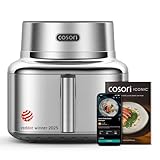
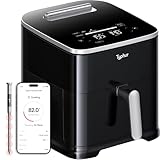
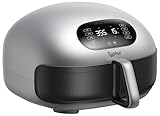
True ceramic non-stick coatings use sol-gel silica or aluminum oxide chemistry — neither contains PFAS, neither releases PFAS at typical cooking temperatures. The Cosori Iconic, Yedi Evolution, Typhur Sync, and Typhur Dome 2 all use this true-ceramic chemistry with explicit PFAS-free disclosure on the product listings. The catch: the consumer term "ceramic non-stick" is loosely regulated, and some products marketed as "ceramic" are PTFE-coated with a ceramic-feel topcoat. EWG PFAS guidance specifically recommends verifying explicit PFAS-free certification rather than relying on "ceramic" marketing alone — which is why we picked products with explicit PFAS-free disclosure rather than just "ceramic-feel" positioning.
Are stainless steel air fryers actually a thing?
Yes but rare in dedicated air fryers — most "stainless steel air fryers" have stainless steel exteriors but ceramic-coated interior baskets. The cleanest stainless-only option in our pick list is the Breville Smart Oven Air Pro (#5), which uses an all-stainless cooking cavity where you bring your own glass or stainless bakeware. It's a toaster-oven-hybrid format rather than a basket air fryer, but for plastic-detox purposes it eliminates the coated-surface variable entirely. The trade-off: food sticks to stainless surfaces more than to non-stick, so you need to use cooking spray, parchment, or a moderate temperature for the food not to stick. Some buyers find this a worthwhile trade for the PFAS-free certainty; others find it too much friction for daily cooking.
Cosori Iconic vs Yedi Evolution — which budget tier should I choose?
Cosori Iconic is the Editor's Pick if budget allows — most-recognized brand, smart Wi-Fi connectivity, explicit PFAS-free ceramic disclosure, dishwasher-safe basket. Yedi Evolution hits the same PFAS-avoidance brief at roughly half the price, with the trade-offs being smaller brand (2K+ reviews vs Cosori's 50K+), no Wi-Fi, and slightly less premium feel. Cooking surface chemistry is equivalent. If you're replacing an existing PTFE air fryer and just want the budget-tier swap, Yedi is the right call. If you're investing in your primary daily-cook appliance, Cosori is worth the premium.
Common mistakes when switching to non-toxic air fryers
Mistake 1: Assuming "ceramic" means "PFAS-free." Some "ceramic non-stick" products are PTFE-coated with a ceramic-feel topcoat — verify explicit PFAS-free certification on the product listing, not just the marketing label. Mistake 2: Using metal utensils on ceramic-coated baskets. Even PFAS-free ceramic coatings can scratch and degrade with metal utensils. Use silicone or wood. Mistake 3: Cranking the temperature to max 450°F constantly. Higher temperatures accelerate any cookware coating wear (including ceramic). Cook at 350-400°F for most foods; reserve 450°F for searing. Mistake 4: Leaving food in the basket after cooking. Even non-stick surfaces benefit from immediate transfer to a plate; sitting food is harder to clean and accelerates surface wear. Mistake 5: Putting ceramic-coated baskets in the dishwasher when manufacturer says hand-wash. Many ceramic baskets are dishwasher-safe (Cosori Iconic, Typhur) but some require hand-wash to preserve coating life — check before tossing it in.