


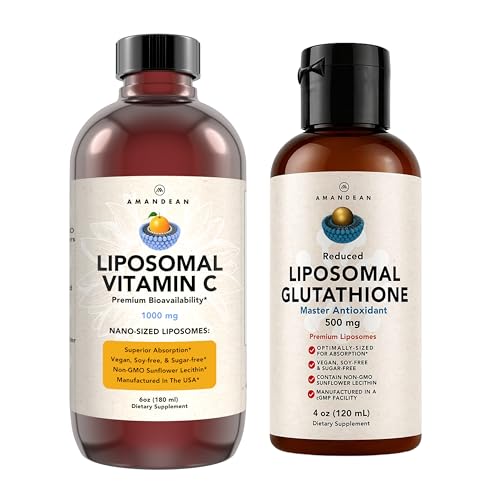
The complete liposomal supplement guide
Liposomal supplementation is one of the rare wellness trends where the science is genuinely solid — when the product actually delivers liposomal encapsulation. Most products labeled "liposomal" on Amazon are emulsions, not true vesicles. Here's how to think about the category.
What does "liposomal" actually mean and why does it matter?
A liposome is a microscopic spherical vesicle made of a phospholipid bilayer (the same lipid molecules that form your cell membranes). The vesicle's interior holds the active ingredient (vitamin C, glutathione, etc.) and the bilayer protects it through stomach acid, then merges with intestinal cells to deliver the cargo intact. The bioavailability advantage comes from two mechanisms: (1) protection from GI degradation, and (2) lipid-mediated absorption pathways that bypass the saturable aqueous uptake that limits regular vitamin C absorption. Most peer-reviewed bioavailability data shows liposomal delivery produces 30-90% higher peak plasma concentrations vs equivalent non-liposomal doses.
Is liposomal vitamin C actually better than regular vitamin C?
Yes — and the difference is bigger at higher doses. Plain oral vitamin C absorption is saturable: at 500 mg you absorb ~75%; at 1000 mg ~50%; at 2000 mg ~30%; at 3000+ mg you absorb <20% with the rest causing GI distress. Liposomal delivery bypasses this saturation curve via lipid-mediated absorption, so 1000-2000 mg liposomal can deliver more bioavailable vitamin C than 5000 mg of plain ascorbic acid. Davis 2016 in Nutrition and Metabolic Insights showed ~40% higher peak plasma vitamin C from liposomal vs non-liposomal at the same nominal dose. For immune-support shoppers, this is the key reason liposomal is worth the price premium.
Does oral glutathione actually work, or is liposomal the only form worth taking?
Non-liposomal oral glutathione doesn't work — Sinha 2018 in the European Journal of Clinical Nutrition showed it produces no measurable increase in blood glutathione because the molecule gets hydrolyzed to amino acids in the gut. Liposomal glutathione DOES work — the same Sinha study showed 25% increase in RBC glutathione and 20-30% reduction in oxidative stress markers at 1000 mg/day for 4 weeks. If you're going to take oral glutathione at all, it has to be liposomal. The same conclusion applies to topical glutathione (mostly ineffective) and IV glutathione (works but expensive and requires medical supervision). Liposomal is the only practical oral route.
Why do most liposomal products combine vitamin C with glutathione?
The two molecules regenerate each other in the body — Lykkesfeldt & Tveden-Nyborg 2019 in Nutrients covers the redox-cycle biology. Vitamin C reduces oxidized glutathione (GSSG) back to active GSH; glutathione reduces oxidized vitamin C (dehydroascorbate) back to active ascorbate. Co-administration extends both molecules' antioxidant half-life — which is why combo products (Intelligent Labs, AMANDEAN, Alpha Flow) consistently outperform single-ingredient products mechanistically. The downside: combo products lock you into a fixed ratio. If you specifically need high-dose glutathione for a chronic-illness protocol, separate single-ingredient Quicksilver Glutathione gives you titration flexibility.
What dose should I take and how long until I see results?
The published evidence supports these dose ranges: vitamin C at 1000-2000 mg/day liposomal (matches Davis 2016 protocol); glutathione at 250-1000 mg/day liposomal (matches Sinha 2018 and Richie 2015 protocols). Timeline expectations: immune-support and energy effects within 1-2 weeks; antioxidant biomarker changes (8-OHdG, protein carbonyls, NK cell activity) measurable at 4-6 weeks; skin-brightening effects (the TikTok-driven use case) typically 8-12+ weeks of consistent daily dosing. Be patient: liposomal supplementation rewards consistency more than intensity.
Common liposomal supplement mistakes
Mistake 1: Assuming all products labeled "liposomal" are actually liposomal. Most are emulsions that don't deliver the bioavailability advantage. Look for brands that publish particle-size data (Quicksilver) or use trademarked raw materials with published research (Setria, Quali-C). Mistake 2: Taking liposomal supplements with hot beverages — heat above 110°F destabilizes the phospholipid bilayer. Use cool water or juice. Mistake 3: Not refrigerating liquid liposomal products after opening — the phospholipids are oxidation-prone. Mistake 4: Combining oral liposomal with IV glutathione protocols without titrating — high-dose stacking can produce sulfur-detox reactions in sensitive users. Mistake 5: Expecting overnight results — peer-reviewed glutathione trials use 4-week minimum protocols. Mistake 6: Skipping the vitamin C co-administration when taking glutathione — without the redox-cycle partner, glutathione's effective half-life is much shorter. Mistake 7: Buying based on milligram dose alone without checking phospholipid content — a product with 2000 mg vitamin C in 200 mg phospholipid is barely liposomal; you want 1:1 or better ratios.